Learning Outcomes:
i. Students will understand the concept of equilibrium and its relation to the balance of forces.
ii. Students will be able to classify equilibrium into different types: stable, unstable, and neutral equilibrium.
iii. Students will identify and analyze examples of each type of equilibrium from everyday life.
iv. Students will appreciate the significance of equilibrium in maintaining stability and preventing motion.
Introduction:
In the realm of physics, equilibrium is a state where all forces acting on an object are balanced, resulting in no net force or acceleration. Objects in equilibrium exhibit a state of rest or uniform motion in a straight line. Understanding equilibrium is crucial for comprehending the motion of objects and the forces that govern their behavior. This lesson delves into the concept of equilibrium, exploring its various types and their practical applications.
i. Types of Equilibrium:
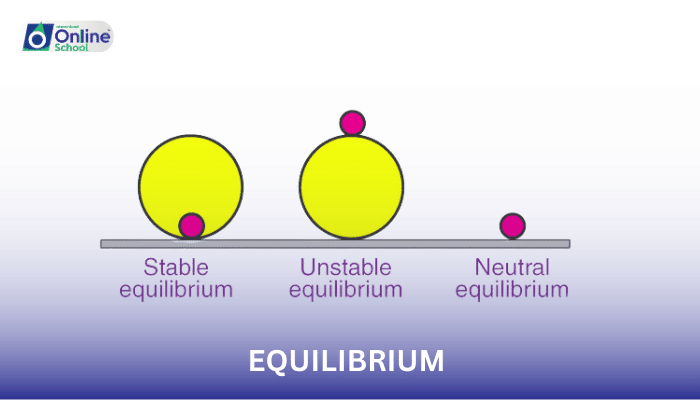
Equilibrium can be classified into three main types based on the behavior of the object when subjected to a small disturbance:
Stable Equilibrium: In stable equilibrium, an object returns to its original position when slightly displaced. This type of equilibrium is characterized by a minimum potential energy configuration. Examples include a book resting on a flat surface or a ball balanced at the bottom of a bowl.
Unstable Equilibrium: In unstable equilibrium, an object moves further away from its original position when slightly displaced. This type of equilibrium is characterized by a maximum potential energy configuration. Examples include a ball balanced on its tip or a person standing on a narrow ledge.
Neutral Equilibrium: In neutral equilibrium, an object remains in its position when slightly displaced and does not move in any particular direction. This type of equilibrium has no net torque acting on the object. Examples include a sphere resting on a flat surface or a ball rolling on a frictionless horizontal surface.
Examples of Equilibrium:
Our everyday surroundings are filled with examples of equilibrium:
A building: A building remains in stable equilibrium due to the balanced forces acting on it, such as the gravitational force pulling it down and the upward force from the ground supporting it.
A bicycle: A bicycle leaning against a wall is in stable equilibrium due to the balance between the gravitational force pulling it down and the frictional force between the tire and the wall.
A boat floating on water: A boat floating on water is in neutral equilibrium due to the balance between the buoyant force pushing it up and the gravitational force pulling it down.
A swinging pendulum: A swinging pendulum oscillates back and forth around its equilibrium position, demonstrating the concept of stable equilibrium.
ii. Significance of Equilibrium:
Equilibrium plays a fundamental role in maintaining stability and preventing motion in various physical systems. It is crucial for structures like buildings and bridges to remain in stable equilibrium to prevent collapse. In everyday life, we rely on equilibrium for objects to remain stationary or move in a predictable manner. Understanding equilibrium is essential for engineers, architects, and designers to create safe and stable structures and systems.
Equilibrium is a cornerstone of physics, providing a framework for understanding the balance of forces and their influence on the motion of objects. By comprehending the different types of equilibrium and their practical applications, students gain a deeper appreciation of the forces that shape our physical world and the factors that contribute to stability and motion.
